Comparison
Solar Panels With or Without a Battery?
A practical comparison of solar-only and solar-plus-battery systems for Irish homes, without assuming storage is automatically better.
August 22, 2026
What a home battery changes
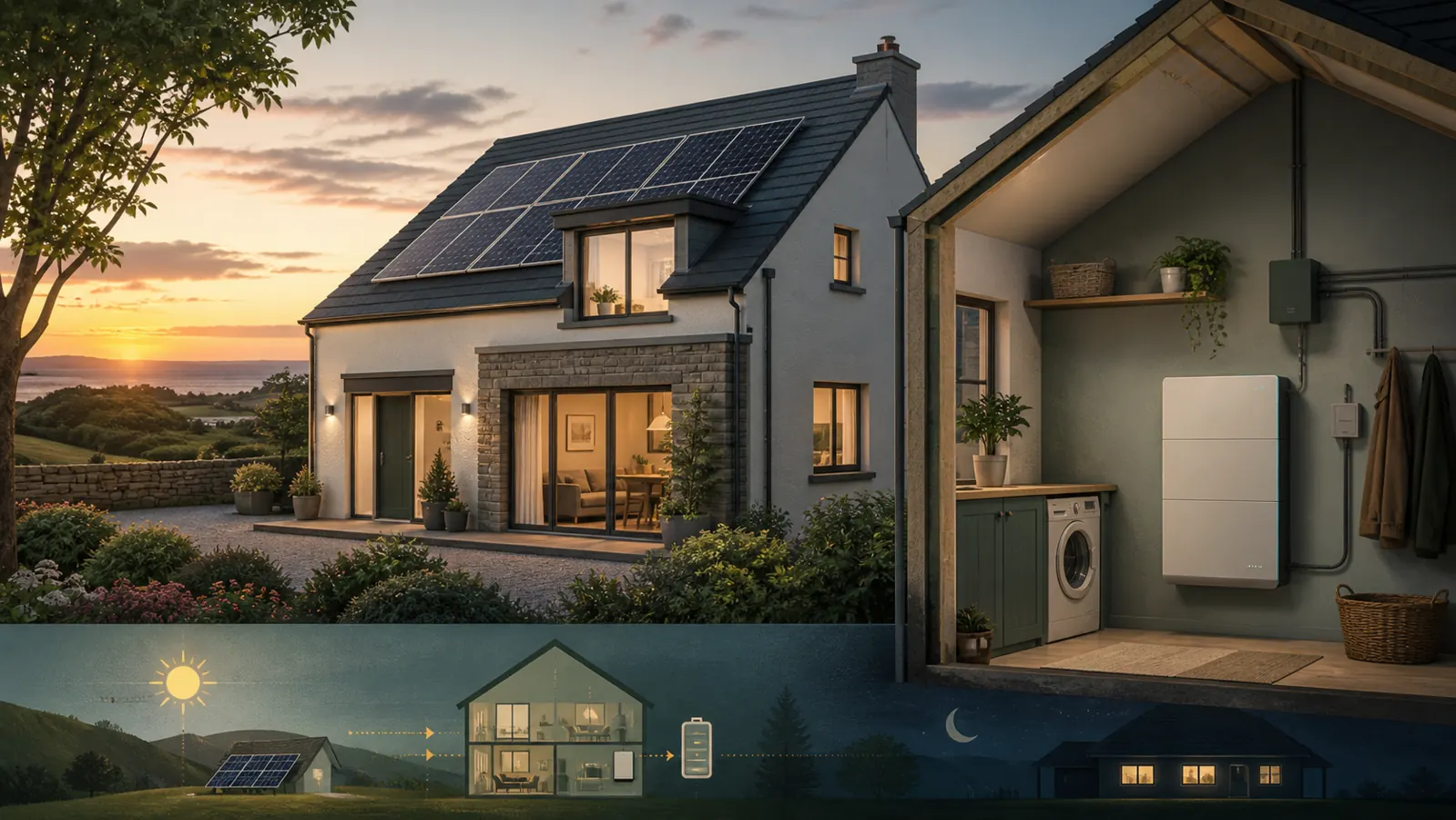
Solar panels generate during daylight. A battery can store some surplus for later, often for use in the evening or at a higher-price tariff period. Without a battery, unused generation can be exported to the grid or directed to another load such as hot water.
Storage can increase the share of solar electricity used in the home, but it also adds cost and loses some energy during charging and discharging. The right choice depends on your usage pattern, tariff, export payment, proposed battery size and how long you expect to own the system.
Solar panels without a battery
A solar-only system is simpler and has a lower initial cost than the same array with storage. It can still reduce imported electricity whenever the home uses power during generation. Surplus electricity can be exported under the Clean Export Guarantee once the connection and metering requirements are in place.
This route may suit a home with regular daytime demand, flexible appliance use, an EV that can charge during sunny periods, or a homeowner who wants to keep the first investment focused on generation. Some inverters and designs can be made battery-ready, but compatibility and future installation costs should be confirmed in writing.
Potential advantages
- Lower initial outlay and fewer components.
- Simpler comparison of panel and inverter performance.
- Exported surplus is paid at the supplier's current rate.
- A battery decision can be revisited after real generation and usage data are available.
Potential limitations
- More surplus may leave the home when daytime demand is low.
- Less solar is available for evening use.
- Adding a battery later may require compatible equipment or further installation work.
Solar panels with a battery
A battery can move electricity from one part of the day to another. It may be useful where solar generation is high at midday but household demand rises after sunset. Some systems can also charge from the grid at a low tariff and discharge when imported electricity is dearer, subject to tariff rules and system settings.
Do not assume every battery provides backup during a power cut. Many grid-connected systems shut down for safety unless specific backup hardware and circuits are installed. Ask exactly what remains powered, for how long and under what conditions.
Potential advantages
- Higher solar self-consumption where daytime use is limited.
- Ability to shift stored energy to evening or peak-price periods.
- Useful monitoring data and more control over import timing.
- Possible backup capability when specifically designed for it.
Potential limitations
- Higher purchase and installation cost.
- Energy losses during charge and discharge.
- Finite usable capacity, power limits and eventual degradation.
- Economics depend on changing tariffs and export rates.
How to compare the two options
Ask for two matched quotations using the same panels, inverter assumptions and annual generation: one without a battery and one with the proposed battery. The battery quote should show usable capacity in kWh, continuous output in kW, expected round-trip efficiency, warranty conditions, warranted throughput or cycles, location requirements and monitoring.
Then compare estimated annual imported electricity, self-consumed solar, exported electricity and savings under the same tariff assumptions. Avoid a payback calculation that counts a stored kWh as if it were created by the battery. The panels create the energy; the battery changes when it is used.
Grant and cost considerations
The 2026 SEAI Solar PV grant is calculated from panel-system capacity up to 4kWp and does not list a separate battery payment. Storage may therefore increase the homeowner's net cost without increasing the grant. See the solar cost guide and grant guide for the current figures.
Questions to ask before adding a battery
- How many kWh of surplus solar does the model expect on a typical day and across the year?
- What usable capacity and output power are proposed?
- What happens when the battery is full?
- Can it charge from the grid, and does that comply with the chosen tariff?
- Does it provide backup, or does it switch off during an outage?
- What are the product, performance and installation warranties?
- Where will it be installed and what ventilation, access or fire-safety requirements apply?
A sensible first version
If the battery case is uncertain, price the solar array on its own and compare storage as a separate decision. Real smart-meter data after installation can show how much surplus is available and when electricity is imported. If future storage matters, make inverter compatibility and space part of the initial design.
Read Are solar panels worth it in Ireland? for the wider decision or visit the Solar Panels hub.
Continue researching
Related solar guides
Solar panel costs in Ireland
Check current official cost benchmarks and what belongs in a complete quote.
Read the cost guide →Solar panel grants in Ireland
Understand current support, eligibility and the order of the application steps.
Read the grant guide →Compare solar installers and quotes
Align system scope, generation assumptions, warranties and contract terms.
Read the quote guide →Not sure where to start?
Use our homeowner guides to understand the options before requesting quotes.