How-to
How Many Solar Panels Do I Need?
A straightforward method for turning household electricity use and usable roof space into a sensible solar PV capacity.
August 22, 2026
Start with kWp, not a panel count
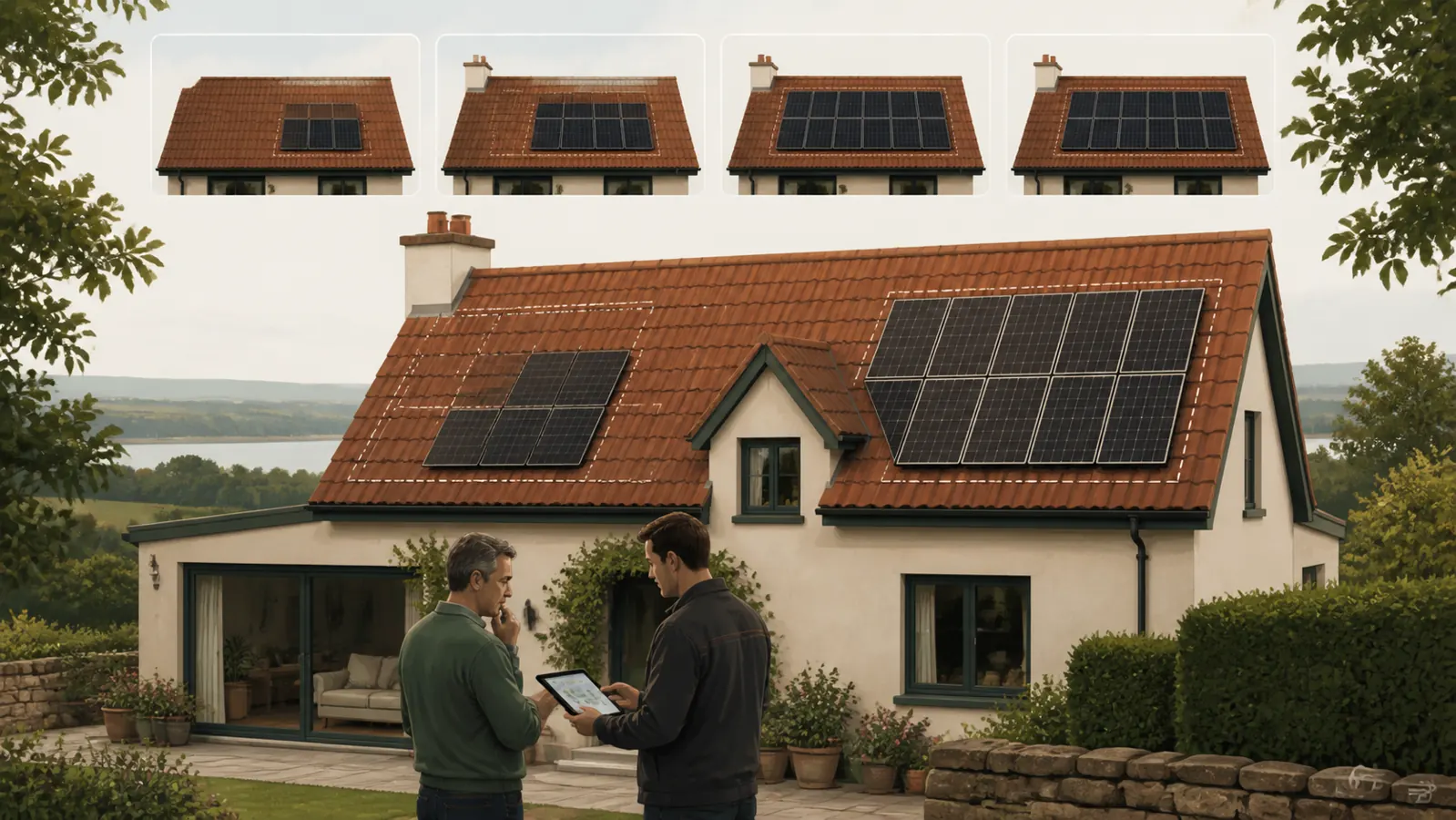
The number of panels is not the best first question because panel power ratings vary. Solar systems are normally described by their kilowatt peak capacity, or kWp. A system using higher-wattage panels can reach the same kWp with fewer panels than one using lower-wattage modules.
For example, eight 440W panels equal 3.52kWp. That is simple arithmetic, not a recommendation. The appropriate capacity depends on your annual and daytime electricity use, roof and export economics.
Check your electricity demand
Gather at least 12 months of electricity bills or smart-meter data. Note total annual kWh, seasonal changes and when the home uses power. A household with daytime activity, electric hot water, an EV or other flexible loads may use more solar as it is generated.
Do not size solely from the monthly euro amount. Tariffs, standing charges and price changes make the bill total a poor proxy for energy demand. Use kWh where possible.
Estimate generation carefully
SEAI gives a practical example of a well-located system of about 3kW and 20 square metres producing around 2,600kWh per year. Its DEAP methodology uses roughly 800kWh per year for each kWp at favourable orientation and without shading as a standard calculation benchmark.
Neither figure predicts your exact output. Location, orientation, pitch, shading, roof layout, equipment and system losses all matter. Ask each installer for the annual kWh estimate, the software or method used and the assumed losses.
Assess the usable roof area
The usable area can be smaller than the visible roof. Chimneys, roof lights, vents, hips, valleys, edge clearances and fire access may restrict placement. SEAI notes that a south-facing, unshaded roof generally produces the most electricity over a year, while east- or west-facing arrays can spread generation towards morning or evening but usually produce less annually.
Roof condition matters too. Panels are expected to remain in place for many years, so repairing or replacing an ageing roof after installation can be costly. A competent survey should consider structure, mounting and access, not only the number of rectangles that fit.
Match generation to use and export
A larger array generates more, but the last panel is not automatically the most valuable. Electricity used directly offsets imported units. Exported electricity earns the rate offered by your supplier, which may be lower than the retail import price you avoid.
Consider at least two scenarios: a system that targets strong self-consumption and a larger system that expects more export. Compare capital cost, estimated annual generation, self-consumed kWh and exported kWh for both. If the quote includes storage, assess it separately using the battery comparison guide.
The grant does not set your ideal size
The 2026 SEAI grant rises with capacity up to 4kWp and then stops at €1,800. This does not mean 4kWp is the right size for every home, nor does it prevent a larger system. It is a funding limit, not a design rule. See the grant guide for the current calculation.
Grid notification can affect larger proposals
CRU says systems below 6kW on single-phase supply or below 11kW on three-phase supply use the NC6 process. Systems above those thresholds, up to 50kW, use NC7. ESB Networks sets the technical connection requirements. A typical homeowner proposal may be within NC6, but the installer should confirm the connection route before work.
Questions for the installer
- What is the proposed capacity in kWp and the wattage of each panel?
- What annual generation is estimated, with what orientation, shading and losses?
- How many kWh are expected to be used in the home and exported?
- What usable roof constraints were included in the design?
- Would a smaller or larger system improve value for this household?
- What changes if an EV, heat pump or battery is added later?
Compare the answers alongside the current cost guide and our installer quote checklist. For the wider topic, visit the Solar Panels hub.
Continue researching
Related solar guides
Solar panel costs in Ireland
Check current official cost benchmarks and what belongs in a complete quote.
Read the cost guide →Solar panel grants in Ireland
Understand current support, eligibility and the order of the application steps.
Read the grant guide →Compare solar installers and quotes
Align system scope, generation assumptions, warranties and contract terms.
Read the quote guide →Not sure where to start?
Use our homeowner guides to understand the options before requesting quotes.